यो अहिलेको लक डाउन परिबेशमा, सधै बाहिर डुली हिड्ने बानी भएको तर हप्तौ देखि घर मै बस्न बिबश एउटा श्रीमान जो आफ्नो श्रीमतीबाट र अप्रत्यक्ष रुपमा कोरोना भाइरसबाट कसरी पिडित भएको महसुस गर्दैछ भन्ने प्रसङ्गमा उस्ले पोखेको दुख, ब्यथा, पीडाहरु समेट्न खोजिएको कोसिस हो। यो पुर्णतया काल्पनीक भए पनि कसैलाई झुक्किएर मिल्न गएमा.. खुच्चिङ्ग, खुच्चिङ्ग खुच्चिङ्ग!
महामारी चलीराखेको छ
म त्रसित छु
यो के भयो ?😲
आखिर कसरी भयो ?🤔
भाइरस के हो?
यस्को अनुहार कस्तो हुन्छ कुन्नी?
सुन्छु नेताहरु ठट्टा पो गर्दैछन आजभोली
भाइरस त निर्जिब तत्त्व हो रे
यो सब बोसोको खेल हो भन्छन डा ओली
डा ट्रम्प चै भन्छन
किटाणुनासक रसायनको इन्जेक्सन लाउने हो कि?
कुरा बुझ्न गार्हो छ
बाहिर ननिस्कन सरकारको आदेश छ
मास्क लगायेको छु
महिना कटि सक्यो
हात धोको धोइ छु
नुहाउनु चै पर्छ कि पर्दैन कुन्नि?
बाहिर जाउ, भाइरसको भय
घरै बसुम्, श्रीमतीको डर
सपनामा त तर्साउ थियौ
अब त बिपनामा पनि यातना दिन सुरु हुने हो कि?
जुन कोठोमा जाउ
भान्छा, बैठक, तल, माथी
पाउछु साथ तिम्रो कहिले नछुट्ने छाया सरि
उ बेलामा नछुट्टिने कसम खाको
मलाइ त लाग्छ
आज कै लागि हो कि?
२ मिटर दुरि राख्ने नियम
घरमा किन लागू हुन्न कुन्नि ?
रामायणको समयमा राम लक्ष्यमणको बनबास
अहिले मेरो घरबास
घरैमा उठिबास
यो चाल कस्ले किन चल्यो कुन्नि ?
अस्ति सम्म हनुमान झै उडि हिडे
गार्हो छ आज घाम देख्न पनि
यो सितेको किड्न्याप हुने चान्स छ कमी
मेरो हरेक चालको अनुमान गर्छे
उल्टै घरमा वसीवसी
रोकतोक गर्छे
मेरो हरेक कामकुराहरु अनुगमन गर्छे
मलाइ त थाहा नै थिएन
पढाइ कत्ती थियो उस्को?
जासुसीमा पो रैछ डिग्री।
घरमा न चुनाब हुन्छ
न प्रजातन्त्र को कदर
बोल्ने अधिकार हनन भा'छ
जुलुस निकाल्न बन्देज ला'छ
दिनदिनै नया अध्यादेस जारी गर्छे
यो घरको खडक प्रसाद ओली।
सम्झदा सपना जस्तो लाग्छ
पहिले दिन दिनै काममा जादा
उनी सङ्ग छुट्नु पर्दा
क्या बेइमान लाग्थ्यो यो जिन्दगी
तस्बिर हेरेर चित्त बुझाउनु पर्थ्यो
अब न तस्बिरको जरुरी
न फोन गर्नु, न कतै जानू
बेइमान त यो भाइरस पो हो कि?
कोरोनाको दिन खै कत्ती छ बाकी?
तर यी बाकी दिनहरु काट्ने कसो गरि?
अहिले नेपाल के?
सन्सारै बन्द, ब्यापर मन्द!
अडेको छ समय
तर घरमा सलबलायेको देख्छु मेरी श्रीमती।
भाइरसले फोक्सोमा आक्रमण गर्छ रे
त्यसैले बाहिर जान डराउछु
काम गरेको नै छु घरमा
पकाको छु
भाडा माझेकै छु
तर बड्दो छ श्रीमतीको दिनदिनै अत्याचार अत्ती।
अस्ति तरकारिमा नुन हाल्न बिर्सदा पनि
घाँटी अठ्याइन उस्ले
पहिले त दालभात पस्किन्थे
अहिले त हातपात गर्न अघि सर्छे
अब कसै गरि मेरो सास फुस्कने
सम्भावना बढेको पो हो कि?
हस्पिटलमा भ्यान्टिलेटरको कमी छ रे
घरमा भ्यान्टिलेसनको
हावा प्रदुषित छ
अक्सिजनको कमी छ
तर बाहिर गए पुलिसको लाठी चार्ज गर्छ
घरमा इन्चार्ज छे श्रीमती।
सफै नगर्ने ठाउ पनि फोहोर देखाइन उस्ले
मोदिको सरसफाइ अभियान
मित्रो!
यो घरमा पो चलाइन उस्ले।
पुछ्नै नपर्ने ठाउमा पनि पुछ्न लागाइन उस्ले
सास फुल्यो, आराम गर्छु एकैछिन भन्दा
अल्छी भयो, ब्यायाम पुगेन भनी
छतमा लगिन उस्ले।
फेसबुकमा लाइभ गयेर
मलाइ सये चोटि उठ्बस गर्न लगाइन उस्ले
इन्टेर्नेट्को कनेस्कन गयो भनेर
अर्को फेरि सये उठ्बस दोहोराइन उस्ले।
खुट्टा मलाइ दुखेको थियो
मालिस आफैलाइ पो गर्न लगाइन उस्ले।
लौ यो लक डाउनले के गर्यो?
मेरो घरको ठेगाना त छ
तर ठेगान् आफ्नो हराइन उस्ले।
मुहार चन्द्रमा जस्तो थियो
कुनै बादलले पो छेक्यो की?
पात्रो हेर्ने भ्याएको थिएन
औँशीको दिन लम्बियो कि?
कन्या राशी थियो उन्को
सिह कसरी हुन गइ?
उस्को आँखा राम्रो थियो
कसैको आँखा लाग्यो कि?
कान मिलेको थियो
कसैले कानेखुसी गरिदियो की?
बोली लड्डु जस्तो गुलियो थियो
काचै करेला चपाइन कि?
अनुहार त झनै राम्रो थियो
मेक अप गरेकी पो थिइन कि?
साच्चैमा भन्नू पर्दा
म त
घर मै बसी बसी
श्रीमती हरायेको मान्छे!
खोजी राखेको छु उनीलाइ
भेटेको छैन अझै
रिपोर्ट गरेको छु
समाचार आएको छैन
पत्रिकामा छापेको छु
खबर पाएको छैन।
बयान गरेको थिएँ
यसरी विस्तारमा..
नपाउने त फेरि शंकै थियन।
खबर आयो चारै तिरबाट
सबैको यउटै कुरो थियो
कसैले सान्तवना भने दिएनन्
कसैले गरे गाली
कसैले दिए सुझाव
कसैले सोधे प्रस्न?
तर सबैले भन्थे त्यहि
"म पनि तिमी जस्तै श्रीमती हरायेको मान्छे।"
के गर्ने, कहाँ खोज्न जाने?
हामीलाई नी शोक छ
बयान एकदमै मिल्दो जुल्दो छ
लान्छौ भने मेरै लैजाउ बरु
तिम्रो श्रीमती त खै कुन्नी।
मेरो पछी हात धोयेर लागी परेको त थियौ नै
हिजोआज त झन राजनितीमा पनि हात हाल्न थाली छ
भाइरसको समस्या जटिल छ भनेर
अस्ति प्रधानमन्त्री डा ओलीलाई फोन गरिछ
यो लक डाउन अझै लम्ब्याउने सुझाब पनि दिइछ।
तर आशा गर्छु एकदिन
श्रीमती आउने छन घर फर्किएर।
राणा शासन त टुङ्गियो एकदिन
भाइरसको रस पनी सुक्ने छ।
अहिलेको लागि खुसी छु
धन्य छु
किन की
अझै केही बितेको छैन
भाग्यले म अझै जिवितै छु।
लौ हिडे अहिलेलाई अलबिदा
दालभात पकाउने पालो आज फेरि मेरै छ।
For so many, camping is a way to connect with nature. Wild Camping is different from usual camping which is not just about going outdoors, but also getting away from the busy campsites and caravan parks, and spending time with nature, truly. Wild camping requires more planning/organising and be prepared/self-sufficient for the whole experience. But there are specific rules that govern access for wild camping in the UK. Scotland allows wild camping anywhere but in England or Wales, there are certain places that we can go wild camping – such as the Lake District and parts of Dartmoor. But where ever you may go, you must check first if you need permission from the landowner. The most important rule to remember is that your wild camping trip should leave no impact on the landscape and shouldn’t disturb the environment or wildlife around you.
So, wild camping is pretty much illegal everywhere else in Britain. But, people still do and that’s technically breaking the law. However, as I read in many places, the general advice is that if you stick to the rules you should be ok. A few things to remember: to camp in a small group, further away from paths (can’t be seen from a distance), towns and villages, pitch after dark and leave just after sunrise. Don’t light fires, take away everything you brought and absolutely Leave No Trace (LNT).
Friday the 2nd October, I went for Wild camping in Surrey Hills (The Areas of Outstanding Natural Beauty) with two of my friends (Sushil and Sulav). The weather forecast was not so brilliant and we had a bit of storm Alex experience in those two days. However, it was an interesting, fun and unexpectedly challenging trip for our first-time wild camping.
We planned and prepared as much as possible, packed our rucksack, and left home after eating an early lunch. Well, at least two of us definitely had our Nepalese style lunch (dal, bhaat, tarkari), but Sulav didn’t, allegedly. We started our walk from Mickleham. It was a bit of struggle to get going, especially walking up hills carrying (a 14kg or more) rucksack for the first time. I never knew, it would be tough. I can’t emphasis enough that you need to be smart about your packing and make sure that our load is as light as possible. But it’s hard to find the balance between weight and necessity that’s right for you.
The plan was to walk at least 21kms before pitching. Halfway, as we stopped for a nice cup of coffee at the Wotton Hatch, we thought of pitching at 16kms near Tillingbourne spring. It was getting late and we were a little tired as well. When we got there, it was almost 7pm and nearly dark. We looked for an area to pitch, a bit far away from the path. But it was all boggy (like a marsh) probably due to a non-stop rain. So, we went looking for a spot to pitch our tent in a higher ground.
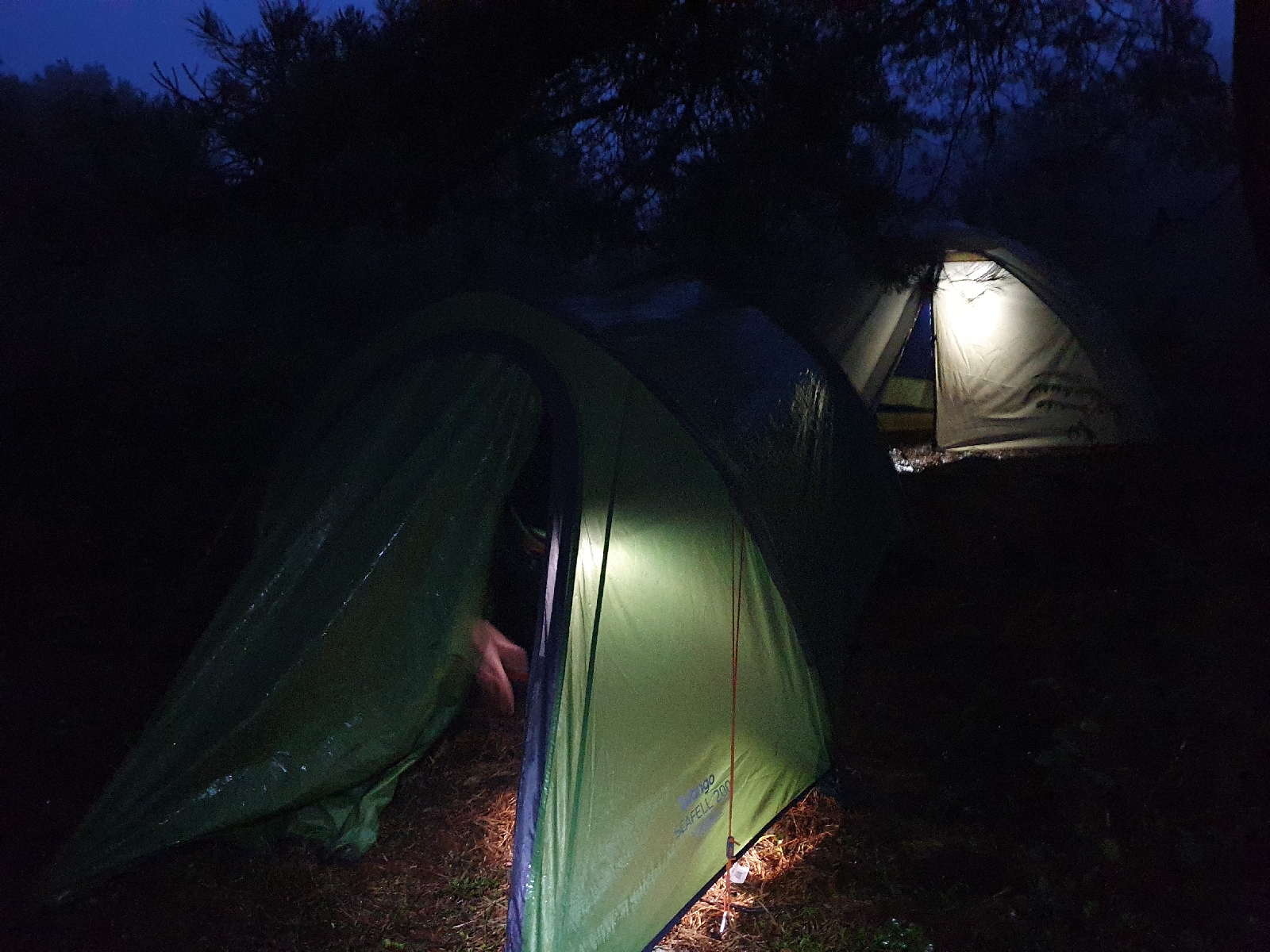
We kept walking up towards Leith Hill and took some time before finding an area flat enough for three of us to pitch. It kept raining, but with our head torch on, we pitched as quickly as we could. We all had a 2P tent. My Vango Langley 600XL tent was heavy (more than 2kgs) but big enough to keep our rucksack, boots inside, out of the rain. Sulav and Sushil pitched near the big tree and I ended up pitching a little far away.
We cooked our food in our own tent and sat together (rather uncomfortably) in Sulav’s tent and eat quickly. We also had a quick ginger tea. I left my saucepan outside hoping to collect some rainwater and also remembered to charge my watch and mobile phone for tomorrow.
We went to bed early, just after 9pm but, I managed to sleep 3 hours or maybe less that night. It rained all day and "poured down" throughout the night. As we were on quite an exposed spot, it was a sleepless night with the sound of the heavy rain hammering on our tent and the gusts of winds made me think if we set up our tents properly and will it survive strong winds? I also kept wondering if water will be running inside our tent. But it wasn't like 50-mph winds or the worst weather we have ever experienced. So we were just fine. However, trying to fall asleep, Sushil said that he tried singing in the rain and I was counting numbers backward, recited Gayatri mantra, and also end up eating a protein bar, Snicker, and a bread roll. But Sulav said that he (allegedly) had a good long sleep and woke up once or twice only. I have absolutely no idea how you could have a good sleep in such a noisy tent!
After a few hours of sleep, I was awake early, just before 5am. It was completely dark outside and still raining. I changed my base layer and made myself warm first. Then, I started cooking my porridge while packing my rucksack at the same time. Sushil and Sulav were also awake and started preparing. Once again, we quickly eat our breakfast and drank a tea/coffee that we prepared with a little bit of water left from last night. Then, we packed up our tent, made sure we didn’t leave any rubbish, and started moving.
Once again, we decided to keep our walk under 16kms. There was no mobile reception in the area where we pitched. So I replanned the route on our way back. Early in the morning, it was a really nice walk back. The trail was almost empty for us to enjoy. We hardly met a few (dog) walkers and runners on the way. The views were splendid after the rain. The greenery was greener than usual and it was just fantastic to see mist/fog. as I like to think it was as if trees were breathing out oxygen for us.
Most of the paths were clear with only a few puddles that we couldn’t avoid. After jumping in just one puddle and a bit of walk, Sushil decided he needs a new waterproof boot for a next trip. We mustn’t forget as well that even if our boots are waterproof, water can get in and run down our legs easily. So, over-trousers and gaiters are always useful which we all had. In fact, I would like to say we are always prepared (over cautious sometimes) because of our experiences from past hiking trips.
Hence, we always find hiking/camping in bad weather as enjoyable as in good weather. Hiking in the rain, light to moderate drizzle is good fun but it could be challenging in heavy rain and wind. So, it is all about taking sensible risks and be a little more prepared for the elements for worthwhile rewards.
A few things to remember based on our experiences and what I learned:
First of all, you should pick a good trail / well-established path (a loop route is even better if you are planning to hike as we did). In bad weather, you should try to avoid steep hills, narrow paths, and wetlands. It is important to check on the weather before leaving and prepare accordingly.
Rucksack/backpack – a rain cover is enough for a light drizzle. In heavy rain, you could use a heavy-duty bin liner to line the inside of your backpack. Use dry / zip-lock bags to keep important equipment/food and other bits dry inside your bag.
A good tent and an extra groundsheet (if you are worried about the rain). Sleeping in a tent in the rain is definitely one of the great joys in life! But if you are like me and can’t sleep with all the noises, do bring earplugs!
You must ensure our tent is safe and secure. Tighten the guy ropes and always bring some spare pegs! If it is raining, keep rucksack and boots inside a tent.
If a heavy downpour/storm is forecast, you should check you aren't camped where it could flood (in a valley or a floodplain). If lots of lightning directly overhead, the advice is to avoid tents or standing under trees or other tall objects that may attract lightning strikes. In such a situation, the best thing to do is to get into full waterproofs, go outside, in low ground, or in a nearby building (if possible) and enjoy the lighting show.
Remember to dress for the temperature. You should bring warm, waterproof clothing and boots and socks. Don’t wear cotton or denim. Invest in a good waterproof and windproof jacket. Is there such thing as the perfect jacket - waterproof, breathable, lightweight, comfortable to wear for a long time, and warm as well? This is probably why we should wear layers. When choosing layers, consider how hot or cold it is and dress appropriately.
Get a good base layer – wicks sweat off your skin. The Middle (insulating) layer – retains body heat and outer (shell) layer – shields from wind and rain. Waterproof paints and Gaiters are also great to keep your socks dry.
You would also need:
A good Sleeping Bag, a liner and Camping mat (folding) is essential.
Camping cooking equipment, lighter.
Shove or trowel, toilet paper, wipes (bio-degradable)
Food - it’s important to remember we are not going for a picnic and take what’s absolutely necessary. Quick snacks that we can eat on the go, such as energy bars and dried fruit/nuts are lifesaver! it’s always a good idea to snack small and often throughout the day. Most of all, always remember to smile, laugh and enjoy!
By the way, once I came home, I did clean and dry my tent properly before packing as storing a damp tent doesn’t do it any good.
A bit long video (< 6 mins) but a collection of our memorable moments.
Note: Saturday 3 October 2020 was the wettest day for UK-wide rainfall since records began in 1891, Met Office researchers have said. The downpour followed in the wake of Storm Alex and saw an average of 31.7mm (1.24ins) of rain across the entire UK. (Source: BBC News 16/10/2020 https://www.bbc.co.uk/news/science-environment-54561601)
This year, for the first time, I ran my very tough 100k ultra challenge. There were only 11 competitors. 7 completed, 2 DNF and 2 ran out of time. In 16 hours and 40 minutes time I was the 4th finisher.
I was really looking forward to running this race and I was very happy that I was able to spend my Sunday taking part in this adventure. Only concern was I didn't really do tapering and my mileage was the highest ever in the week before the race. That's a very bad idea and I suffered for it. Lesson learned.
The route followed the National Trail known as the Chiltern Way. The scenery was stunning, rolling fields, farms, woodland and villages. The 100km race started in Little Hamden winding clockwise back to Hemel Hempstead finishing at HQ (Feldon Lodge in Hemel Hempstead) where we stayed overnight. Sunday early morning, we were driven to the start location for a quick briefing and race started exactly at 7am.
It was a pure test of the determination and focus of all the runners, in such an unforgiving weather conditions. It was windy and rained all day. (Not complaining about the weather but just mentioning how it was). The route was very challenging and full of rural technical. At many places, there were no obvious paths to follow and I ran on a lot of nettle strewn paths 😂. There were plenty of freshly ploughed fields where it was even impossible to walk.
Although the trail is signed, some way-marks aren't obvious or are overgrown. Running here also required constant navigation, which is ok if you're walking. There wasn't anybody who didn't get lost (frequently). Even following gpx route on my watch wasn't easy. But using my watch did save me from making any major navigational errors. Overall, I ran 106.2 km.
Considering battery life, I started charging my watch halfway through the race to make sure I've the route to follow in the night. We were also given 'trackers' to attach to our race packs so we could be followed online.
There were 3 checkpoints approximately every 25km. Amazing volunteers helped us with water, tea, coke, fruits and plenty of food from the back of the car. At the finish, organisers were ready with more hot food, fruits and drinks. I didn't have any refulling issues.
First 10 miles I ran with a couple of runners but than slowed down due to sharp pain in my left knee. I ran the rest of the route on my own. Running in night time with the head torch was a bit stressful at first but then I quickly got used to it. I can confirm I didn't see any ghosts 👻 (भुत) and lucky not to meet any scary cattle🐮.
This race was by far the hardest thing I’ve done. Regardless of all the challenges, yesterday I felt mentally very strong all the way through. It has not always been the same experience before. Nowadays I find the quality in my runs not due to how far or how fast I could run but how much I could learn. Learning is, in fact, life long ambition.
So running isn't just about races and PBs. It is a journey full of ups and downs, just like in our real life and being strong and having faith and not giving up is the only option.
In every race we run, we learn so much not just about running or running silly distances, but about ourselves as a person. We learn to be mindful, appreciate what we have and make the most of it. With the love and support from our family and amazing friends, we can achieve beyond our imagination. It's true.
This race was an epic challenge and it has to be by far, the biggest medal that I've ever received so far.
Continue training and I'll hopefully be able to run the biggest ultra challenge centurion 100 miles race next year. Through NNAUK, supporting their project to build a birthing centre in a remote village, it has also helped me find a worthy reason to get through all the long miles and hard training. Thanks to all who supported me and already donated for this cause I'm running for. If you'd like to support: please use this Link:https://goo.gl/CT7ScL
Once again, if you're interested I'm always happy to share my challenges, training, the routines, struggles, attempts, endurance, the life changing experiences and reflections with you. We can always learn so much from each other. Once again, thank you very much for your support. नमस्ते।
50k Sussex Weald ultra Challenge - a very well organised, well marked trail race. It was a beautiful day today but tough conditions to run. A challenging course and there were plenty of hills too. However, I thoroughly enjoyed and love to go back again. Now, I just need to keep training and be ready for my biggest challenge so far, 100km race in August 26th.
Thanks to all who supported me and also donated for the worthy cause I'm running for. If you'd like to support: please use this Link:https://goo.gl/CT7ScL
Finished 85th out of 201 runners in 05:53:20. The race followed the long distance paths of the Weald Way and the Vanguard Way, encompassing the surrounding beauty of the Sussex countryside en route. The course was approximately 85% off-road along the picturesque and undulating routes with a great variety of landscapes containing rolling hills, ancient woodlands and irregular shaped fields (hence twisted my left ankle twice and it's still sore). Time for a speedy recovery and continue training...
I ran my first ever London Marathon on Sunday (22nd April). It was truly a running festival and I've had an unforgettable experience 🤔.
There were tens of thousands of people lined the streets from the start to the end to cheer on friends, family – and everybody else. All the way, you could see people enjoying the sunny day with the loud music, drums, singing, dancing and having fun while more than 42,000 runners tried to complete the challenge in the hottest London Marathon ever. But, forget about the heat, at one point, I got tired of smiling, saying thank you to all the strangers shouting my name and hi5ing 100s of kids. I felt like I was celebrating 'running'.
26.2 miles (42.2kms) is of course a long way to run on the punishing hard surface (road). Your body does suffer a lot as you try to push your limit. It's mentally even more challenging to keep going when you know you've already done enough around 20 miles.
That's when I almost pulled my left hamstring twice and started feeling a sharp pain in my left-side glute. Not that I was running fast, however I had to slow down and lost my pace that I was trying to maintain (around 5:30 mins/km). Except that, I think I managed well in the heat as I kept drinking some water and pour the rest on my head and the rest of my body. I also enjoyed running through the showers. In fact, I paused for a bit every time as it reminded me of my childhood days back home when we use to run around in the long awaited monsoon rain in a very hot day. I probably enjoyed the water a bit too much that even my shocks were wet and felt my shoes heavy. But I can't complain. I was there to enjoy the race and so I did.
Running is meaningful and it's good to run for a reason. Some people run marathons to step out of their Comfort Zone and for the sense of accomplishment as running a marathon is one of the largest physical challenges you can set for yourself. Those addicted to running will run any races, anyhow. Some get inspired by others and some manage to inspire others to do something they thought was too tough or impossible. Some run for a PB (time) and some to use the run as a means to raise money and awareness. This year, for the first time, I also combined my running ambition with the goal of helping NNAUK by raising money to build a birthing centre in a remote district of Nepal. I'll also be running very challenging ultra 50k and 100k races this year. So I've no time to rest but carry on training. The inspiration and motivation that I am helping others will help me get through all the long miles and hard training. Thanks to all who supported me and also donated for the worthy cause I'm running for. If you'd like to support: please use this Link: https://goo.gl/CT7ScL
Now, when I go back to trails, I'll probably get disappointed not to hear my name called almost every few meters that I run 😁. But, I love trail running. I totally enjoy the sounds of nature and the sights, the excitement and adventure that I can experience. You will exercise all your muscles but it will also give you the time and space to think, the peace and opportunity to reset your mind. It's defintely more interesting than running on roads, as you feel so engaged and aware on the trails. Lucky if you live near the mountains but you can just go and explore your local parks and hills and enjoy trail running. I can't wait to go to the top of a Box hill, stop and watch the sun rise again...
London Marathon 2018: (Finish Time: 04:08:29) Total number of finishers recorded: 40,273. My place overall: 11240. Place gender: 8470. The hottest Race Day on record. 24°C
Recently, a massive earthquake of a magnitude 7.9 struck Nepal. In Gorkha district (the epicenter of the earthquake), we also lost our family home but luckily our families survived. It’s difficult to explain the extent of the damage but this was a particularly large earthquake and thousands of people died and lost their homes.
There are several organisations actively providing relief to families, but mainly in Kathmandu. At this time of tragedy, communities around the world are doing whatever possible to reach the villages with emergency supplies. Unfortunately, in remote villages, many schools have fallen and thousands of children don't have a school to go to.
We are raising fund so we could help rebuild at least one of the schools that has been destroyed by the earthquake. We would like to support Janasakti Primary School in Arutar, Gorkha, where my wife studied as a child.
We ran three half marathon in 2015. This year, the plan so far:
MK Marathon 2016
The "Cyril Bean" Coventry Way 40 miles Challenge: Sunday 3rd April 2016
We have never run so many races before. Besides working full time and with family commitments, training for so many races have been very tough. But I am sure your donations and support will motivate and inspire us to complete these challenges successfully. With the generous help from our friends and families, so far we have raised £1200. We will ensure every penny donated here will directly go to the school. Will you please join us in supporting our school in need?
You can either donate with Paypal or if you don’t have a PayPal account, you can donate using your credit card or bank account. Your kind support will be really appreciated.
If you are interested in detail about our fund raising activities and if you want to find out how the donations are being collected and where we are helping with your help, please visit this open Facebook group. Thank you very much. Raphi and Sujan.
In Ubuntu 14.04 LTS, you can install VirtualBox easily from the Ubuntu Software Centre. The available version is 4.3.10. Unfortunately I was unable to install in Dell Latitude E6400 laptop. It complained:
'VT-x is disabled in the BIOS. (VERR_VMX_MSR_VMXON_DISABLED).'
Instead of trying to fix this issue, I simply decided to install the most recent version of VirtualBox which is 4.3.18.
To install:
For my distribution, I added the following lines to my /etc/apt/sources.list:
deb http://download.virtualbox.org/virtualbox/debian trusty contrib
Then, download, add and register the Oracle public key for apt-secure using following command:
For more detailed official installation instruction, please follow this link. On the page, Ubuntu/Debian users are recommended to install the dkms package to ensure that the VirtualBox host kernel modules (vboxdrv, vboxnetflt and vboxnetadp) are properly updated if the linux kernel version changes during the next apt-get upgrade.
For Debian it is available in Lenny backports and in the normal
repository for Squeeze and later. The dkms package can be installed
through the Synaptic Package manager or through the following command:
Mobile devices can play an important role in facilitating the technology enhanced learning. But, providing a successful mobile learning service is still a challenge in developing countries. The need is to increase the focus on using relatively cheaper and sustainable mobile technologies to support education and design solutions based on the distinct understandings of local context to fully embed technology in the existing educational process. For my PhD, I conducted a qualitative research study by taking a bottom-up approach to understand the user requirements, the educational context and the challenges for supporting mobile learning in the context of Nepal. I also explored the potential of low-cost open-source mobile devices (Ben Nanonote and Wikireader) to provide a one-stop offline access to learning materials to evaluate the perceived benefits and challenges of such technology to support learning. Here, I would like to discuss the research problem, my research approach and the summary of the findings and limitations. I will also try to highlight the possible implications for the design of future mobile learning that might be useful for guiding the technological intervention in the schools of Nepal.
There are ongoing efforts focused on developing the type of low-cost device targeted for developing countries, as the technologies developed for the first world have often been a poor fit in these area, due to issues of cost, infrastructure, physical environment, and social factors (Toyama & Ali, 2009). Now, the wider availability and adoption of the portable mobile devices around the world has given numerous opportunities for economic and social development even in poor developing countries. Mobile capabilities are increasingly explored to realise productivity and efficiency in variety of contexts such as to improve health, governance, agriculture and business by meeting day-to-day communication and information needs. As the concept and idea of using mobile devices for education in and outside classroom is also growing, the investment in the exploration of mobile technology for educational purposes is also in rise and expected to deliver the learning outcomes.
The relatively new field of ‘mobile learning’ is rapidly gaining momentum looking for teaching and learning opportunities even in the remotest areas of developing countries. However, mobile devices are not common in education due to difficulty of adapting technology to the users need and vice versa (Deegan & Rothwell, 2010). Many of the mobile learning researches that have examined the use of mobile devices in a wide range of learning settings present the positive outcome, overlooking the far more complex challenges of embedding mobile learning applications, sustaining and scaling for future remains (Traxler, 2011). The mobile learning literature clearly points out that the focus on the technology aspect has been more than necessary and the challenges remains associated with how the technology is adopted and used for mobile learning. Regardless of how advanced the mobile technology is today, the usability challenges associated with mobile devices and mobile learning applications, and designs without the knowledge of the specific user group and the context(s) of use (Deegan & Rothwell, 2010) raises grave concern to implement a successful solution. It is therefore crucial for technology research to identify the best-fit solutions for developing regions (Brewer et al., 2005) that take account of the existing teaching and learning practices, social and cultural practices of the locality to make sure it is a sustainable solution and for long-term use and benefits (Evans et al., 2008).
My primary research aim was centred on the evaluation of the perceived benefits of low-cost open-source platforms WikiReader and Nanonote by investigating its potential to provide one-stop access to learning materials at anytime anywhere. The research question that this research specifically aimed to address was: “What are the benefits and difficulties of introducing technology for supporting schools’ education in Nepal and how might we design mobile learning using open-source platforms to exploit these benefits and overcome the challenges?”
Research Approach
This research introduced a pocket size Linux computer, Nanonote and a text-only reading device, Wikireader, to support mobile learning activities. In this research, the pilot and the main study were carried out in two different learning settings. The pilot study was a preliminary study conducted in order to assess feasibility of open devices to provide offline access to learning resources.
The main study explored how an offline mobile learning solution based on the Nanonote and Wikireader devices may address the knowledge requirements of teachers to facilitate English language teaching and learning in the challenging learning environment of schools of Nepal. 5 English teachers from 2 public and 2 private schools participated in this study. This evaluative study analysed the teachers’ interactions with devices, students and the environment during the deployment period.
As part of this study, to develop the distinct understandings of Nepal’s schools’ education and to identify the type of useful resources for teaching and learning, three sub-studies were initially conducted around this theme. An exploratory study was conducted in 8 public schools with no access to ICT. As private schools are generally believed to be
believed to better than public schools, a similar study was conducted in 8 private schools with limited or no access to ICT. All of these schools were located within an urban area of Chitwan district and 2 English teachers (total 32) from each school participated.
A further study involved 8 English teachers from 8 public schools with an access to XO laptops. These schools were located in 4 different districts (Makwanpur, Lalitpur, Mustang and Kapilvastu) of Nepal. The aim of this study was to examine the benefits and challenges of using ICT in schools and understand how the use of ICT may be helping to solve some of the concerns identified from the earlier study.
Mixtures of qualitative methods such as questionnaires, diary study, observation, semi-structured face to face and telephone interviews were used to collect primary data. The study also relied on the secondary data based on Nepal's established newspapers (e.g. Nepalnews, The Kathmandu Post, The Himalyans) that discuss the political changes and the Nepal's development in the present context. All the data were transcribed, summarised, coded and categorised manually.
Pilot Study
The learning context for the pilot study was of teaching and learning embedded programming in the University of West London (Shrestha, Moore, & Nocera, 2011). It explored how students perceived and used these devices, and how well they believed these devices supported their learning activities. The study demonstrated the potential of open devices to support hands-on approach in learning embedded programming that enhanced motivation to learn without being restricted to the limited practical sessions in the university lab. This study recommended further explorations of a mobile learning solution that provided offline ready access to learning resources, as lack of internet connection was not seen as a limitation in this learning context.
Sub-studies
In Nepal, majority of schools are government funded. But the number of private schools is also increasing. Generally, students from private schools perform better than those from public schools and the pass percentage of school leaving certificate exam has significantly dropped in last three years. The commercialisation of education and the duel education system (public and private schools) of Nepal are two major causes of concerns. To address the pedagogical issues, this qualitative study focused on teaching and learning English language, which is not succeeding in public schools and the study also highlights the relevant issues of educational and social injustice in Nepal. The study showed that due to lack of focus on tackling the political, pedagogical, social and cultural issues, the ‘school divide’ is increasing and fuelling the ‘social divide’ that already exists in an ethnically and socio-culturally diverse Nepalese society. These studies also reveal one of the current and the urgent requirements is to provide an access to digital resources to support teaching and learning. There are opportunities and possibilities to enhance learning by incorporating technology in the existing educational process. However, the challenges are to develop a sustainable TEL solution with the bottom-up understanding of the existing pedagogical, technological, political, social and cultural challenges and embed into the learning context.
Main Study
In this study, a specific technological innovation (low-cost open-source devices) was deployed in an educational setting to study the technical feasibility and pedagogic possibility in a context that presented environmental and infrastructural challenges to deliver and support education with conventional e-Learning technologies (Traxler, 2007). Therefore, the focus was to evaluate the open-source devices in the formalised context (Frohberg, 2006), a traditional teaching setting of schools in Nepal to support teaching English within a well-defined curriculum of class 9 and 10. The devices were used to provide an offline access to relevant learning resources (content based application) to facilitate teaching that took place in a behaviourist one-to-many manner in a classroom environment to more communicative approach of language learning. The direct users of the devices were the teachers who were responsible for teaching English subject and played a central role to facilitate teaching and learning. This research investigated how the introduction of mobile learning may (achieve contingent learning) by changing the teachers teaching due to the changing affordances. It highlighted the possibility of reducing the transactional distances between instructor and students of traditional classroom and increased the students’ class interactivity. Therefore, this study helped to design a simple mobile learning solution using low-cost open-source devices by understanding the users’ need, the challenging context and reducing the related issues to increase the chances of successfully embedding the solution in to the educational context where it is expected to be used.
Conclusions
In developing countries, the penetration of mobile technology is relatively higher than the desktop computers and the idea of using mobile devices to learn and access educational tools and materials is also growing. However, regardless of rapid development of mobile tools and technologies, supporting learning in Nepal’s public schools faces numerous challenges. Some of the technical challenges of delivering mobile learning in Nepal are the lack of stable communication infrastructure and access to mobile devices and mobile internet. There is also lack of access to ICT and relevant learning resources in local and the English languages and capacity to use.
This study also showed the increase in disparities in public and private schools and its impact on increasing the divide in Nepal’s education and society. The clear need is for the state’s top-down interventions to influence these issues, strong policies to improve the public schools, manage and monitor private schools, and ensure everybody receives opportunities for better education. Therefore, selection of affordable TEL devices suitable for delivering learning to suits such resource-constrained setting is a huge challenge.
This study explored the potential of low-cost open-source mobile devices (Ben Nanonote and Wikireader) to provide a one-stop offline access to learning materials and evaluated its perceived benefits and challenges to support learning. The study found that compared to the existing traditional methods used in language teaching and learning, mobile learning intervention helped to facilitate the student-centred approach. However, even though open platforms can overcome the major technical issues of constrained locked-down hardware and proprietary software, it’s a challenge to develop a custom software and content to fully appreciate the potential of these devices. Most importantly, there is also a need for a broader longitudinal study to investigate its potential role in developing regions as supporting mobile learners in their own socio-cultural contexts is a significant challenge.
This exploratory study has been an attempt to highlight the importance of considering an appropriate mobile platform to deliver and support learning as one of the key aspects of a sustainable mobile learning design. Before establishing aspects of technical feasibility of a mobile device in specific educational subjects and settings, the challenge is to select the flexible platform based on the clear understanding of the requirement of the curriculum, the need to support students meet their academic needs, the issues related to existing pedagogy used, the limitations of available tools and the learning environment.
At the moment, I am in the middle of analysing the data I collected and writing up all the studies I did. Also, with the understanding of the context, the users and the need, I am raising fund to install a low power server to deploy a digital library (E-Pustakalaya) and setup a local network and provide an offline access to this e-library in one of the public school in Nepal where I studied myself. It will enable better user experience through fast offline access and quick downloads.
The estimated cost is around Rs. 80,000 and planned to install in November 2012 with the help of OLE Nepal. This will include all the hardware equipment, travel costs, on-site installation and network, and orientation to local community members on how to use the digital library. I have so far raised £300. The detail budget plan is as below:
The breakdown of the costing per school for one time elibrary installation and orientation:1. Equipment: Rs. 37,000- 2. Travel, Transport, Insurance: Rs. 6,000- 3. Technical setup & Orientation at schools: Rs. 28,000-
With the help from OLE Nepal and my dad (who is a dedicated social worker and a retired teacher, who taught more than 30 years in this school), we will encourage the school to adopt and use this offline library. I can assure you that your kind support and suggestions will be really appreciated and acknowledged.
You can email me (sunnysujan at gmail dot com). Twitter @ sunnysujan. My homepage: www.sunnysujan.co.uk
If we could raise more than expected, the available fund will be used to setup similar sustainable offline learning solution in other public schools where digital access to educational materials will be very useful. Thank you very much.
References Brewer, E., Demmer, M., Du, B., Ho, M., Kam, M., Nedevschi, S., Pal, J., et al. (2005). The case for technology in developing regions. Computer, 38(6), 25–38. doi:10.1109/MC.2005.204 Deegan, R., & Rothwell, P. (2010). A Classification of M-Learning Applications from a Usability Perspective. Journal of the Research Center for Educational Technology, 6(1), 16–27. Evans, M. A., Johri, A., Glasson, G. E., Cagiltay, K., Pal, J., & Sorcar, P. (2008). ICT4D and the learning sciences. Proceedings of the 8th international conference on International conference for the learning sciences - Volume 3 (pp. 229–236). Utrecht, The Netherlands: International Society of the Learning Sciences. Retrieved from http://portal.acm.org/citation.cfm?id=1599936.1600022&coll=GUIDE&dl=GUIDE&CFID=86443088&CFTOKEN=66786693 Frohberg, D. (2006). Mobile Learning is Coming of Age - What we have and what we still miss. DeLFI (pp. 327–338). Shrestha, S., Moore, J., & Nocera, J. A. (2011). Evaluation of a hands-on approach to learning mobile and embedded programming. International Journal of Mobile Learning and Organisation, 5(3/4), 327. doi:10.1504/IJMLO.2011.045321 Toyama, K., & Ali, M. (2009). Computing for global development: is it computer science research? SIGCOMM Computer Communication Review, 39(5), 40–43. doi:10.1145/1629607.1629616 Traxler, J. (2007). Defining, Discussing and Evaluating Mobile Learning: The moving finger writes and having writ . . . . The International Review of Research in Open and Distance Learning, 8(2). Retrieved from http://www.irrodl.org/index.php/irrodl/article/viewArticle/346/875 Traxler, J. (2011). Research Essay: Mobile Learning. International Journal of Mobile and Blended Learning (IJMBL), 3(2), 57–67. doi:10.4018/IJMBL.2011040111040105