
Introduction

There are ongoing efforts focused on developing the type of low-cost device targeted for developing countries, as the technologies developed for the first world have often been a poor fit in these area, due to issues of cost, infrastructure, physical environment, and social factors (Toyama & Ali, 2009). Now, the wider availability and adoption of the portable mobile devices around the world has given numerous opportunities for economic and social development even in poor developing countries. Mobile capabilities are increasingly explored to realise productivity and efficiency in variety of contexts such as to improve health, governance, agriculture and business by meeting day-to-day communication and information needs. As the concept and idea of using mobile devices for education in and outside classroom is also growing, the investment in the exploration of mobile technology for educational purposes is also in rise and expected to deliver the learning outcomes.


The relatively new field of ‘mobile learning’ is rapidly gaining momentum looking for teaching and learning opportunities even in the remotest areas of developing countries. However, mobile devices are not common in education due to difficulty of adapting technology to the users need and vice versa (Deegan & Rothwell, 2010). Many of the mobile learning researches that have examined the use of mobile devices in a wide range of learning settings present the positive outcome, overlooking the far more complex challenges of embedding mobile learning applications, sustaining and scaling for future remains (Traxler, 2011). The mobile learning literature clearly points out that the focus on the technology aspect has been more than necessary and the challenges remains associated with how the technology is adopted and used for mobile learning. Regardless of how advanced the mobile technology is today, the usability challenges associated with mobile devices and mobile learning applications, and designs without the knowledge of the specific user group and the context(s) of use (Deegan & Rothwell, 2010) raises grave concern to implement a successful solution. It is therefore crucial for technology research to identify the best-fit solutions for developing regions (Brewer et al., 2005) that take account of the existing teaching and learning practices, social and cultural practices of the locality to make sure it is a sustainable solution and for long-term use and benefits (Evans et al., 2008).


My primary research aim was centred on the evaluation of the perceived benefits of low-cost open-source platforms WikiReader and Nanonote by investigating its potential to provide one-stop access to learning materials at anytime anywhere. The research question that this research specifically aimed to address was: “What are the benefits and difficulties of introducing technology for supporting schools’ education in Nepal and how might we design mobile learning using open-source platforms to exploit these benefits and overcome the challenges?”
Research Approach

 The main study explored how an offline mobile learning solution based on the Nanonote and Wikireader devices may address the knowledge requirements of teachers to facilitate English language teaching and learning in the challenging learning environment of schools of Nepal. 5 English teachers from 2 public and 2 private schools participated in this study. This evaluative study analysed the teachers’ interactions with devices, students and the environment during the deployment period.
As part of this study, to develop the distinct understandings of Nepal’s schools’ education and to identify the type of useful resources for teaching and learning, three sub-studies were initially conducted around this theme. An exploratory study was conducted in 8 public schools with no access to ICT. As private schools are generally believed to be
believed to better than public schools, a similar study was conducted in 8 private schools with limited or no access to ICT. All of these schools were located within an urban area of Chitwan district and 2 English teachers (total 32) from each school participated.
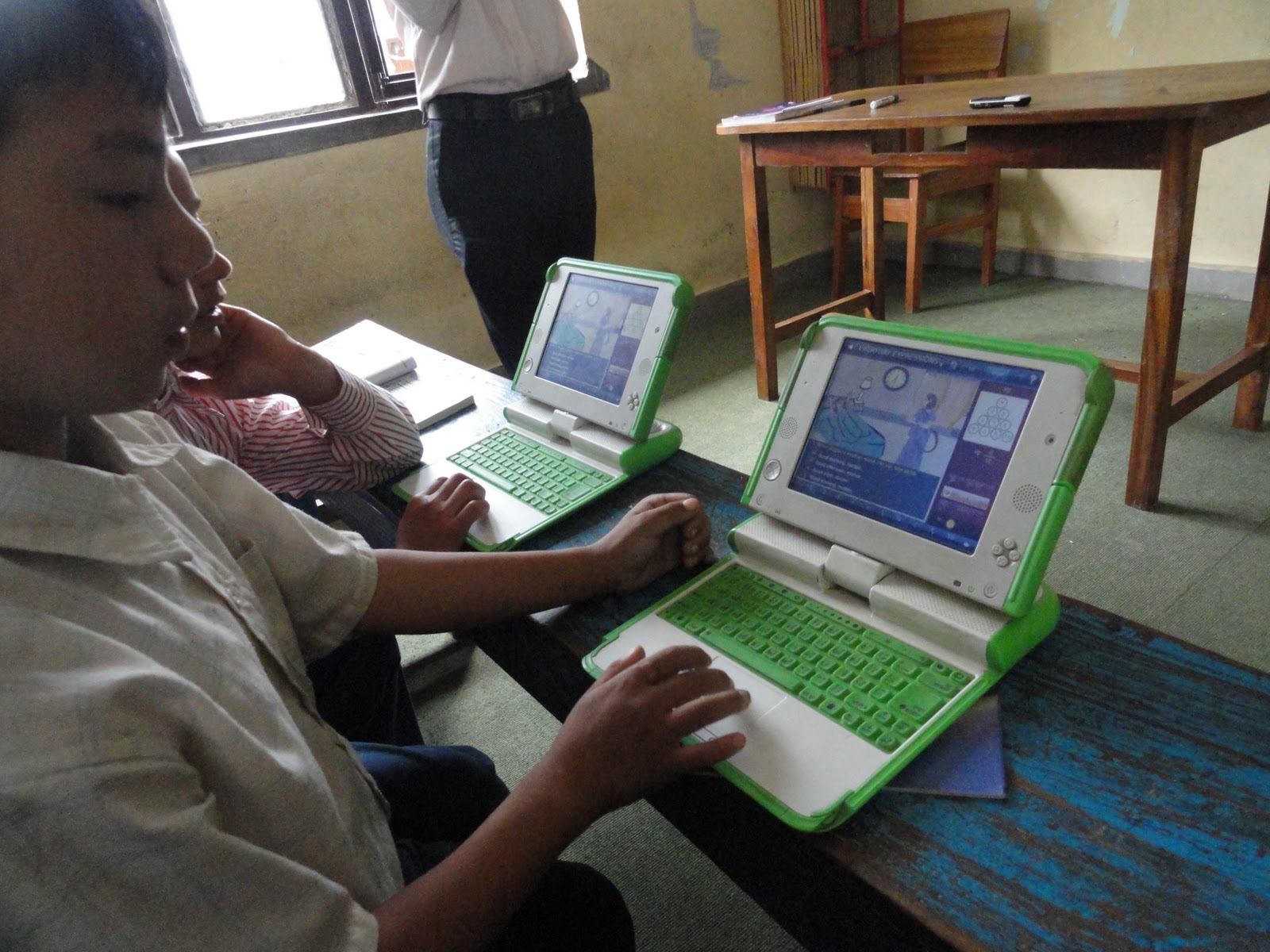
 A further study involved 8 English teachers from 8 public schools with an access to XO laptops. These schools were located in 4 different districts (Makwanpur, Lalitpur, Mustang and Kapilvastu) of Nepal. The aim of this study was to examine the benefits and challenges of using ICT in schools and understand how the use of ICT may be helping to solve some of the concerns identified from the earlier study.
Mixtures of qualitative methods such as questionnaires, diary study, observation, semi-structured face to face and telephone interviews were used to collect primary data. The study also relied on the secondary data based on Nepal's established newspapers (e.g. Nepalnews, The Kathmandu Post, The Himalyans) that discuss the political changes and the Nepal's development in the present context. All the data were transcribed, summarised, coded and categorised manually.
Pilot Study

Sub-studies
 In Nepal, majority of schools are government funded. But the number of private schools is also increasing. Generally, students from private schools perform better than those from public schools and the pass percentage of school leaving certificate exam has significantly dropped in last three years. The commercialisation of education and the duel education system (public and private schools) of Nepal are two major causes of concerns. To address the pedagogical issues, this qualitative study focused on teaching and learning English language, which is not succeeding in public schools and the study also highlights the relevant issues of educational and social injustice in Nepal. The study showed that due to lack of focus on tackling the political, pedagogical, social and cultural issues, the
 ‘school divide’ is increasing and fuelling the ‘social divide’ that already exists in an ethnically and socio-culturally diverse Nepalese society. These studies also reveal one of the current and the urgent requirements is to provide an access to digital resources to support teaching and learning. There are opportunities and possibilities to enhance learning by incorporating technology in the existing educational process. However, the challenges are to develop a sustainable TEL solution with the bottom-up understanding of the existing pedagogical, technological, political, social and cultural challenges and embed into the learning context.
Main Study

In this study, a specific technological innovation (low-cost open-source devices) was deployed in an educational setting to study the technical feasibility and pedagogic possibility in a context that presented environmental and infrastructural challenges to deliver and support education with conventional e-Learning technologies (Traxler, 2007). Therefore, the focus was to evaluate the open-source devices in the formalised context (Frohberg, 2006), a traditional teaching setting of schools in Nepal to support teaching English within a well-defined curriculum of class 9 and 10. The devices were used to provide an offline access to relevant learning resources (content based application) to facilitate teaching that took place in a behaviourist one-to-many manner in a classroom environment to more communicative approach of language learning. The direct users of the devices were the teachers who were responsible for teaching English subject and played a central role to facilitate teaching and learning. This research investigated how the introduction of mobile learning may (achieve contingent learning) by changing the teachers teaching due to the changing affordances. It highlighted the possibility of reducing the transactional distances between instructor and students of traditional classroom and increased the students’ class interactivity. Therefore, this study helped to design a simple mobile learning solution using low-cost open-source devices by understanding the users’ need, the challenging context and reducing the related issues to increase the chances of successfully embedding the solution in to the educational context where it is expected to be used.
Conclusions
In developing countries, the penetration of mobile technology is relatively higher than the desktop computers and the idea of using mobile devices to learn and access educational tools and materials is also growing. However, regardless of rapid development of mobile tools and technologies, supporting learning in Nepal’s public schools faces numerous challenges. Some of the technical challenges of delivering mobile learning in Nepal are the lack of stable communication infrastructure and access to mobile devices and mobile internet. There is also lack of access to ICT and relevant learning resources in local and the English languages and capacity to use.


This study also showed the increase in disparities in public and private schools and its impact on increasing the divide in Nepal’s education and society. The clear need is for the state’s top-down interventions to influence these issues, strong policies to improve the public schools, manage and monitor private schools, and ensure everybody receives opportunities for better education. Therefore, selection of affordable TEL devices suitable for delivering learning to suits such resource-constrained setting is a huge challenge.
This study explored the potential of low-cost open-source mobile devices (Ben Nanonote and Wikireader) to provide a one-stop offline access to learning materials and evaluated its perceived benefits and challenges to support learning. The study found that compared to the existing traditional methods used in language teaching and learning, mobile learning intervention helped to facilitate the student-centred approach. However, even though open platforms can overcome the major technical issues of constrained locked-down hardware and proprietary software, it’s a challenge to develop a custom software and content to fully appreciate the potential of these devices. Most importantly, there is also a need for a broader longitudinal study to investigate its potential role in developing regions as supporting mobile learners in their own socio-cultural contexts is a significant challenge.
This exploratory study has been an attempt to highlight the importance of considering an appropriate mobile platform to deliver and support learning as one of the key aspects of a sustainable mobile learning design. Before establishing aspects of technical feasibility of a mobile device in specific educational subjects and settings, the challenge is to select the flexible platform based on the clear understanding of the requirement of the curriculum, the need to support students meet their academic needs, the issues related to existing pedagogy used, the limitations of available tools and the learning environment.
At the moment, I am in the middle of analysing the data I collected and writing up all the studies I did. Also, with the understanding of the context, the users and the need, I am raising fund to install a low power server to deploy a digital library (E-Pustakalaya) and setup a local network and provide an offline access to this e-library in one of the public school in Nepal where I studied myself. It will enable better user experience through fast offline access and quick downloads.
The estimated cost is around Rs. 80,000 and planned to install in November 2012 with the help of OLE Nepal. This will include all the hardware equipment, travel costs, on-site installation and network, and orientation to local community members on how to use the digital library. I have so far raised £300. The detail budget plan is as below:
[ Rs. 80,000 = £576.77 = 903.73 USD = 741.07 EUR = 869.50 AUD ]
The breakdown of the costing per school for one time elibrary installation and orientation:1. Equipment: Rs. 37,000-
2. Travel, Transport, Insurance: Rs. 6,000-
3. Technical setup & Orientation at schools: Rs. 28,000-
4. Procurement & installation: Rs. 5,500-
5. Office overhead: Rs. 3,500-
Total : Rs 80,000-
5. Office overhead: Rs. 3,500-
Total : Rs 80,000-
With the help from OLE Nepal and my dad (who is a dedicated social worker and a retired teacher, who taught more than 30 years in this school), we will encourage the school to adopt and use this offline library. I can assure you that your kind support and suggestions will be really appreciated and acknowledged.
You can email me (sunnysujan at gmail dot com). Twitter @ sunnysujan. My homepage: www.sunnysujan.co.uk
If we could raise more than expected, the available fund will be used to setup similar sustainable offline learning solution in other public schools where digital access to educational materials will be very useful.
Thank you very much.
References
Brewer, E., Demmer, M., Du, B., Ho, M., Kam, M., Nedevschi, S., Pal, J., et al. (2005). The case for technology in developing regions. Computer, 38(6), 25–38. doi:10.1109/MC.2005.204
Deegan, R., & Rothwell, P. (2010). A Classification of M-Learning Applications from a Usability Perspective. Journal of the Research Center for Educational Technology, 6(1), 16–27.
Evans, M. A., Johri, A., Glasson, G. E., Cagiltay, K., Pal, J., & Sorcar, P. (2008). ICT4D and the learning sciences. Proceedings of the 8th international conference on International conference for the learning sciences - Volume 3 (pp. 229–236). Utrecht, The Netherlands: International Society of the Learning Sciences. Retrieved from http://portal.acm.org/citation.cfm?id=1599936.1600022&coll=GUIDE&dl=GUIDE&CFID=86443088&CFTOKEN=66786693
Frohberg, D. (2006). Mobile Learning is Coming of Age - What we have and what we still miss. DeLFI (pp. 327–338).
Shrestha, S., Moore, J., & Nocera, J. A. (2011). Evaluation of a hands-on approach to learning mobile and embedded programming. International Journal of Mobile Learning and Organisation, 5(3/4), 327. doi:10.1504/IJMLO.2011.045321
Toyama, K., & Ali, M. (2009). Computing for global development: is it computer science research? SIGCOMM Computer Communication Review, 39(5), 40–43. doi:10.1145/1629607.1629616
Traxler, J. (2007). Defining, Discussing and Evaluating Mobile Learning: The moving finger writes and having writ . . . . The International Review of Research in Open and Distance Learning, 8(2). Retrieved from http://www.irrodl.org/index.php/irrodl/article/viewArticle/346/875
Traxler, J. (2011). Research Essay: Mobile Learning. International Journal of Mobile and Blended Learning (IJMBL), 3(2), 57–67. doi:10.4018/IJMBL.2011040111040105