Tuesday, October 16, 2012

Learning experiences in the real world: exploring the potential of low-cost open source platforms for mobile learning in Nepal


Mobile devices can play an important role in facilitating the technology enhanced learning. But, providing a successful mobile learning service is still a challenge in developing countries. The need is to increase the focus on using relatively cheaper and sustainable mobile technologies to support education and design solutions based on the distinct understandings of local context to fully embed technology in the existing educational process. For my PhD, I conducted a qualitative research study by taking a bottom-up approach to understand the user requirements, the educational context and the challenges for supporting mobile learning in the context of Nepal. I also explored the potential of low-cost open-source mobile devices (Ben Nanonote and Wikireader) to provide a one-stop offline access to learning materials to evaluate the perceived benefits and challenges of such technology to support learning. Here, I would like to discuss the research problem, my research approach and the summary of the findings and limitations. I will also try to highlight the possible implications for the design of future mobile learning that might be useful for guiding the technological intervention in the schools of Nepal.


Keywords: mobile learning, ICT4E, ICT4D, open-source platform, technology enhanced learning, Nepal, copyleft hardware, Nanonote, Wikireader


Introduction


There are ongoing efforts focused on developing the type of low-cost device targeted for developing countries, as the technologies developed for the first world have often been a poor fit in these area, due to issues of cost, infrastructure, physical environment, and social factors (Toyama & Ali, 2009). Now, the wider availability and adoption of the portable mobile devices around the world has given numerous opportunities for economic and social development even in poor developing countries. Mobile capabilities are increasingly explored to realise productivity and efficiency in variety of contexts such as to improve health, governance, agriculture and business by meeting day-to-day communication and information needs. As the concept and idea of using mobile devices for education in and outside classroom is also growing, the investment in the exploration of mobile technology for educational purposes is also in rise and expected to deliver the learning outcomes.


The relatively new field of ‘mobile learning’ is rapidly gaining momentum looking for teaching and learning opportunities even in the remotest areas of developing countries. However, mobile devices are not common in education due to difficulty of adapting technology to the users need and vice versa (Deegan & Rothwell, 2010). Many of the mobile learning researches that have examined the use of mobile devices in a wide range of learning settings present the positive outcome, overlooking the far more complex challenges of embedding mobile learning applications, sustaining and scaling for future remains (Traxler, 2011). The mobile learning literature clearly points out that the focus on the technology aspect has been more than necessary and the challenges remains associated with how the technology is adopted and used for mobile learning. Regardless of how advanced the mobile technology is today, the usability challenges associated with mobile devices and mobile learning applications, and designs without the knowledge of the specific user group and the context(s) of use (Deegan & Rothwell, 2010) raises grave concern to implement a successful solution. It is therefore crucial for technology research to identify the best-fit solutions for developing regions (Brewer et al., 2005) that take account of the existing teaching and learning practices, social and cultural practices of the locality to make sure it is a sustainable solution and for long-term use and benefits (Evans et al., 2008).


My primary research aim was centred on the evaluation of the perceived benefits of low-cost open-source platforms WikiReader and Nanonote by investigating its potential to provide one-stop access to learning materials at anytime anywhere.  The research question that this research specifically aimed to address was: “What are the benefits and difficulties of introducing technology for supporting schools’ education in Nepal and how might we design mobile learning using open-source platforms to exploit these benefits and overcome the challenges?”

Research Approach

This research introduced a pocket size Linux computer, Nanonote and a text-only reading device, Wikireader, to support mobile learning activities. In this research, the pilot and the main study were carried out in two different learning settings. The pilot study was a preliminary study conducted in order to assess feasibility of open devices to provide offline access to learning resources.

The main study explored how an offline mobile learning solution based on the Nanonote and Wikireader devices may address the knowledge requirements of teachers to facilitate English language teaching and learning in the challenging learning environment of schools of Nepal. 5 English teachers from 2 public and 2 private schools participated in this study. This evaluative study analysed the teachers’ interactions with devices, students and the environment during the deployment period.

As part of this study, to develop the distinct understandings of Nepal’s schools’ education and to identify the type of useful resources for teaching and learning, three sub-studies were initially conducted around this theme. An exploratory study was conducted in 8 public schools with no access to ICT. As private schools are generally believed to be
believed to better than public schools, a similar study was conducted in 8 private schools with limited or no access to ICT. All of these schools were located within an urban area of Chitwan district and 2 English teachers (total 32) from each school participated.

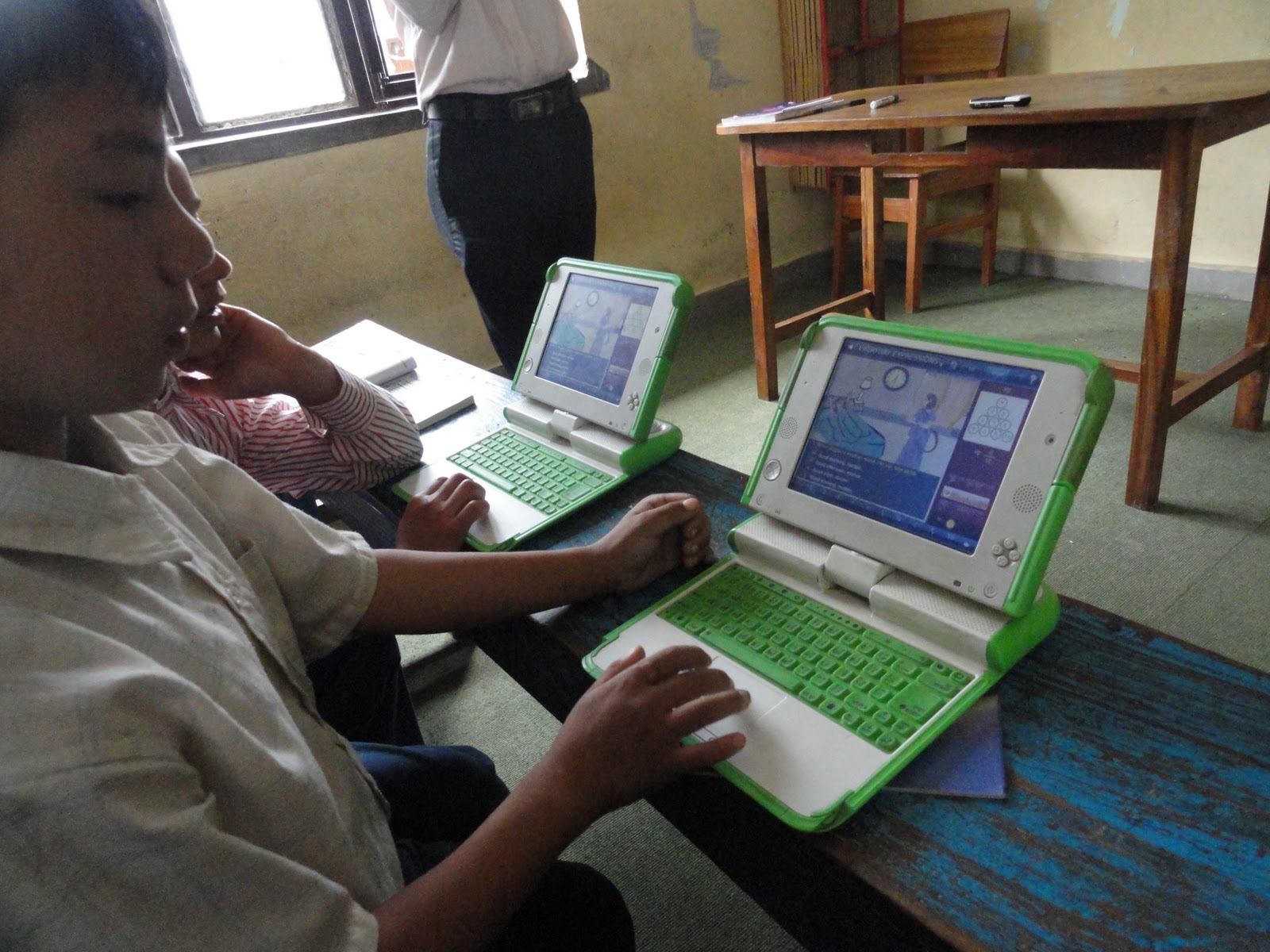
A further study involved 8 English teachers from 8 public schools with an access to XO laptops. These schools were located in 4 different districts (Makwanpur, Lalitpur, Mustang and Kapilvastu) of Nepal. The aim of this study was to examine the benefits and challenges of using ICT in schools and understand how the use of ICT may be helping to solve some of the concerns identified from the earlier study.

Mixtures of qualitative methods such as questionnaires, diary study, observation, semi-structured face to face and telephone interviews were used to collect primary data. The study also relied on the secondary data based on Nepal's established newspapers (e.g. Nepalnews, The Kathmandu Post, The Himalyans) that discuss the political changes and the Nepal's development in the present context. All the data were transcribed, summarised, coded and categorised manually.

Pilot Study

The learning context for the pilot study was of teaching and learning embedded programming in the University of West London (Shrestha, Moore, & Nocera, 2011). It explored how students perceived and used these devices, and how well they believed these devices supported their learning activities. The study demonstrated the potential of open devices to support hands-on approach in learning embedded programming that enhanced motivation to learn without being restricted to the limited practical sessions in the university lab. This study recommended further explorations of a mobile learning solution that provided offline ready access to learning resources, as lack of internet connection was not seen as a limitation in this learning context.

Sub-studies 


In Nepal, majority of schools are government funded. But the number of private schools is also increasing.  Generally, students from private schools perform better than those from public schools and the pass percentage of school leaving certificate exam has significantly dropped in last three years. The commercialisation of education and the duel education system (public and private schools) of Nepal are two major causes of concerns. To address the pedagogical issues, this qualitative study focused on teaching and learning English language, which is not succeeding in public schools and the study also highlights the relevant issues of educational and social injustice in Nepal. The study showed that due to lack of focus on tackling the political, pedagogical, social and cultural issues, the
‘school divide’ is increasing and fuelling the ‘social divide’ that already exists in an ethnically and socio-culturally diverse Nepalese society.  These studies also reveal one of the current and the urgent requirements is to provide an access to digital resources to support teaching and learning. There are opportunities and possibilities to enhance learning by incorporating technology in the existing educational process. However, the challenges are to develop a sustainable TEL solution with the bottom-up understanding of the existing pedagogical, technological, political, social and cultural challenges and embed into the learning context.

Main Study


In this study, a specific technological innovation (low-cost open-source devices) was deployed in an educational setting to study the  technical feasibility and pedagogic possibility in a context that presented environmental and infrastructural challenges to deliver and support education with conventional e-Learning technologies (Traxler, 2007). Therefore, the focus was to evaluate the open-source devices in the formalised context (Frohberg, 2006), a traditional teaching setting of schools in Nepal to support teaching English within a well-defined curriculum of class 9 and 10. The devices were used to provide an offline access to relevant learning resources (content based application) to facilitate teaching that took place in a behaviourist one-to-many manner in a classroom environment to more communicative approach of language learning. The direct users of the devices were the teachers who were responsible for teaching English subject and played a central role to facilitate teaching and learning. This research investigated how the introduction of mobile learning may (achieve contingent learning) by changing the teachers teaching due to the changing affordances. It highlighted the possibility of reducing the transactional distances between instructor and students of traditional classroom and increased the students’ class interactivity. Therefore, this study helped to design a simple mobile learning solution using low-cost open-source devices by understanding the users’ need, the challenging context and reducing the related issues to increase the chances of successfully embedding the solution in to the educational context where it is expected to be used.

Conclusions

In developing countries, the penetration of mobile technology is relatively higher than the desktop computers and the idea of using mobile devices to learn and access educational tools and materials is also growing. However, regardless of rapid development of mobile tools and technologies, supporting learning in Nepal’s public schools faces numerous challenges. Some of the technical challenges of delivering mobile learning in Nepal are the lack of stable communication infrastructure and access to mobile devices and mobile internet. There is also lack of access to ICT and relevant learning resources in local and the English languages and capacity to use.


This study also showed the increase in disparities in public and private schools and its impact on increasing the divide in Nepal’s education and society. The clear need is for the state’s top-down interventions to influence these issues, strong policies to improve the public schools, manage and monitor private schools, and ensure everybody receives opportunities for better education.  Therefore, selection of affordable TEL devices suitable for delivering learning to suits such resource-constrained setting is a huge challenge.
This study explored the potential of low-cost open-source mobile devices (Ben Nanonote and Wikireader) to provide a one-stop offline access to learning materials and evaluated its perceived benefits and challenges to support learning. The study found that compared to the existing traditional methods used in language teaching and learning, mobile learning intervention helped to facilitate the student-centred approach. However, even though open platforms can overcome the major technical issues of constrained locked-down hardware and proprietary software, it’s a challenge to develop a custom software and content to fully appreciate the potential of these devices. Most importantly, there is also a need for a broader longitudinal study to investigate its potential role in developing regions as supporting mobile learners in their own socio-cultural contexts is a significant challenge.
This exploratory study has been an attempt to highlight the importance of considering an appropriate mobile platform to deliver and support learning as one of the key aspects of a sustainable mobile learning design. Before establishing aspects of technical feasibility of a mobile device in specific educational subjects and settings, the challenge is to select the flexible platform based on the clear understanding of the requirement of the curriculum, the need to support students meet their academic needs, the issues related to existing pedagogy used, the limitations of available tools and the learning environment.

At the moment, I am in the middle of analysing the data I collected and writing up all the studies I did. Also, with the understanding of the context, the users and the need, I am raising fund to install a low power server to deploy a digital library (E-Pustakalaya) and setup a local network and provide an offline access to this e-library in one of the public school in Nepal where I studied myself. It will enable better user experience through fast offline access and quick downloads.

The estimated cost is around Rs. 80,000 and planned to install in November 2012 with the help of OLE Nepal. This will include all the hardware equipment, travel costs, on-site installation and network, and orientation to local community members on how to use the digital library. I have so far raised £300. The detail budget plan is as below:

[ Rs. 80,000 = £576.77 = 903.73 USD = 741.07 EUR = 869.50 AUD ]

The breakdown of the costing per school for one time elibrary installation and orientation:1. Equipment: Rs. 37,000-
2. Travel, Transport, Insurance: Rs. 6,000-
3. Technical setup & Orientation at schools: Rs. 28,000-
4. Procurement & installation: Rs. 5,500-
5. Office overhead: Rs. 3,500-
Total : Rs 80,000-


With the help from OLE Nepal and my dad (who is a dedicated social worker and a retired teacher, who taught more than 30 years in this school), we will encourage the school to adopt and use this offline library. I can assure you that your kind support and suggestions will be really appreciated and acknowledged.

You can email me (sunnysujan at gmail dot com). Twitter @ sunnysujan. My homepage: www.sunnysujan.co.uk

If we could raise more than expected, the available fund will be used to setup similar sustainable offline learning solution in other public schools where digital access to educational materials will be very useful.
Thank you very much.


References
Brewer, E., Demmer, M., Du, B., Ho, M., Kam, M., Nedevschi, S., Pal, J., et al. (2005). The case for technology in developing regions. Computer, 38(6), 25–38. doi:10.1109/MC.2005.204
Deegan, R., & Rothwell, P. (2010). A Classification of M-Learning Applications from a Usability Perspective. Journal of the Research Center for Educational Technology, 6(1), 16–27.
Evans, M. A., Johri, A., Glasson, G. E., Cagiltay, K., Pal, J., & Sorcar, P. (2008). ICT4D and the learning sciences. Proceedings of the 8th international conference on International conference for the learning sciences - Volume 3 (pp. 229–236). Utrecht, The Netherlands: International Society of the Learning Sciences. Retrieved from http://portal.acm.org/citation.cfm?id=1599936.1600022&coll=GUIDE&dl=GUIDE&CFID=86443088&CFTOKEN=66786693
Frohberg, D. (2006). Mobile Learning is Coming of Age - What we have and what we still miss. DeLFI (pp. 327–338).
Shrestha, S., Moore, J., & Nocera, J. A. (2011). Evaluation of a hands-on approach to learning mobile and embedded programming. International Journal of Mobile Learning and Organisation, 5(3/4), 327. doi:10.1504/IJMLO.2011.045321
Toyama, K., & Ali, M. (2009). Computing for global development: is it computer science research? SIGCOMM Computer Communication Review, 39(5), 40–43. doi:10.1145/1629607.1629616
Traxler, J. (2007). Defining, Discussing and Evaluating  Mobile Learning: The moving finger writes and having writ . . . . The International Review of Research in Open and Distance Learning, 8(2). Retrieved from http://www.irrodl.org/index.php/irrodl/article/viewArticle/346/875
Traxler, J. (2011). Research Essay: Mobile Learning. International Journal of Mobile and Blended Learning (IJMBL), 3(2), 57–67. doi:10.4018/IJMBL.2011040111040105

Friday, July 20, 2012

Pledge: Setting up an Offline Digital Library in Public School of Nepal


Many of us support various charitable organisations in developing countries like Nepal and regularly make generous donations to help achieve their aim and objectives. However, I just like to request for your support for helping a public school in Narayangarh, Chitwan, Nepal to set-up a completely offline digital library.

As we know education is the backbone of a nation. But, in Nepal, schools are failing. There are handful of private schools in urban areas that achieve good results but are inaccessible to majority of the population. Most of the schools in Nepal are public (government funded) and only about 46% of student from these schools pass the School Leaving Exam.

Last year, as part of my study, I visited various public, private and OLPC schools supported bye Open Learning Exchange (OLE) Nepal and spoke to many teachers. Of course, there are various complex social, cultural, political, infrastructural and educational challenges and there are no technology short-cuts to good education (Toyama). However, the traditional teaching and learning methods can be changed, if not at least supported by providing access to useful and relevant digital resources.

"There is a common misconception that ICT-based Education is about teaching students computer skills. ICT-based Education is about using computers and technology as tools to enrich learning in various subjects such as English, Science and Mathematics" (www.olenepal.org). It will require some work and time just to change this view towards Technology Enhanced Learning in a developing country like Nepal. E-library can also help to understand how technology can be used and support teaching and learning.

"E-Pustakalaya (E-Library) is an education-focused digital library containing full-text documents, books, images, videos, audio files, and interactive educational software that can be accessed through an intranet or on the Internet. OLE Nepal started the development of E-Pustakalaya in 2008 with the aim to improve children’s reading skills and develop a reading culture in schools by giving them free and open access to age-appropriate reading materials and to enable students to do research projects and promote habit of independent inquiry. Since E-Pustakalaya went live in 2009, teachers as well as other adults have also benefited widely from various teaching resources, and educational materials in agriculture, health, environment, local technologies, etc." (www.olenepal.org)

The library is accessible on the Internet at www.pustakalaya.org. But Internet access in Nepal is either limited or slow and expensive. In my school (Balkumari higher secondary school, Narayangarh) there are set of desktop computers already. So the plan is to install a low power server to deploy this digital library and setup a local network and provide an offline access to the library. It will enable better user experience through fast access and quick downloads.


As there are few existing computers in the school, we will just need to buy one machine and few network equipment to get E-Pustakalaya running there. The exact cost depends on the location, but the estimate is that it will be around Rs. 80,000. This will include all the hardware equipment, travel costs, on-site installation and network, and orientation to local community members on how to use the digital library. When available, I will post the detail budget plan.

[ Rs. 80,000 = £576.77 = 903.73 USD = 741.07 EUR = 869.50 AUD ]

The breakdown of the costing per school for one time elibrary installation and orientation:1. Equipment: Rs. 37,000-
2. Travel, Transport, Insurance: Rs. 6,000-
3. Technical setup & Orientation at schools: Rs. 28,000-
4. Procurement & installation: Rs. 5,500-
5. Office overhead: Rs. 3,500-
Total : Rs 80,000-


The work will be closely monitored, and the progress will be reported through the relevant media. With the help from my dad (who is a dedicated social worker and a retired teacher, who taught more than 30 years in this school), we will encourage the school to adopt and use this offline library. I can assure you that your kind support and suggestions will be really appreciated and acknowledged.

You can email me (sunnysujan at gmail dot com). Twitter @ sunnysujan. My homepage: www.sunnysujan.co.uk

If we could raise more than expected, the available fund will be used to setup similar library in another public school.
Thank you very much.


Wednesday, December 21, 2011

Writing for Publication: My Experience So Far


PhD is about doing a good research and getting recognition in the research community and it is desirable to have a list of recognized ‘publications’ at the completion.  I'm a second year full-time PhD student from the school of computing and technology and the nature of my research is more amenable to progressive publication. So far, I have published two journal papers; eleven papers and posters in conferences, workshops and a doctor consortium; and co-authored three papers with supervisors and a colleague.  I have also participated in various events, students’ conferences and a summer school abroad.

Publishing is rewarding and intellectually satisfying experience. During this period, I have travelled to eight different countries and met with researchers around the world from engineering and the social sciences. It has provided a great opportunity to share my research experience, received valuable feedback and suggestions which will immensely help to improve the quality of my PhD thesis. But, due to limited available funding from the University, it has been an expensive experience of attending conferences and travelling.

The supervisor’s encouragement and support has played an important role but to manage resources and support necessary to facilitate publication have been challenging. Publishing is a time consuming process and writing coherent chapters for a thesis simultaneously and in time will not be easy. Because of this I have limited my academic and social activities within the school and outside.

However, by publishing in stages, it has exposed me to a process of continual review and criticism from a wider community within my research domain. I am also learning to deal with rejections constructively.  I find it an efficient strategy for researching in rapidly evolving technological context as it avoids a risk of publishing outdated information and data at the conclusion of a study. But publishing early is also risky as it is difficult to have a clearly developed idea to start with and changing the direction at the later stage can be problematic. However, my publication experience has been positive so far and the advantages outweigh the difficulties that I encountered during the process.

Sunday, December 11, 2011

Gnome Classic Desktop in Ubuntu 11.10

I think Gnome Classic Shell is more flexible and easy to use and I prefer this over Ubuntu Unity.  I'm not sure if Unity is up to the standards that we expect from a Linux desktop. Of course Gnome 3.0 looks professional and is very cool but I prefer simple and flexible workspace. After using all the possible UIs, I found myself comfortable using the classic. Not a big concern or issue, I also prefer to have the missing ubuntu logo in Applications menu. I also prefer to use the old style unified applet containing all of the indicators.

Install the Classic Desktop in Ubuntu 11.10 by just clicking this link or use the following command:

     sudo apt-get install gnome-session-fallback

Log out , select Gnome Classic and log in.
You can customise the panel by using Alt + right-mouse-button sequence.  If you use compiz, use Alt+Windows-logo-key+ right-mouse-button.
To replace standard notifications area and use the old style “A unified applet containing all of the indicators”, you can update your system with unsupported packages by adding ppa:jconti/gnome3 to your system's Software Sources. This is from this untrusted PPA.

     sudo add-apt-repository ppa:jconti/gnome3
     sudo apt-get update
     sudo apt-get install indicator-applet-complete

Then, remove clock, notification area and user switch applet, and add a unified applet containing all of the indicators to the panel.

(source) If you want Ubuntu logo to be displayed in ‘Applications’ menu, open /usr/share/themes/Ambiance/gtk-3.0/apps/gnome-panel.css file and change this block of code:

PanelMenuBar.menubar.menuitem {
    background-image: -gtk-gradient (linear, left top, left bottom,
                                     from (shade (@dark_bg_color, 1.5)),
                                     to (shade (@dark_bg_color, 1.05)));
}
to this:
PanelMenuBar.menubar.menuitem {
    background-image: -gtk-gradient (linear, left top, left bottom,
                                     from (shade (@dark_bg_color, 1.5)),
                                     to (shade (@dark_bg_color, 1.05)));
    -PanelMenuBar-icon-visible: true;
}

Tuesday, November 22, 2011

Nepal: Education and technology related papers

The following list is by no means exhaustive. I'll keep updating the list of useful publications related to education and technology in the context of Nepal.

Shields, Robin(2011) 'ICT or I see tea? Modernity, technology and education in Nepal', Globalisation,  Societies and Education', Volume 9 Issue 1, Pages 85-97.

Shields, Robin (2008) Uneven terrain: educational policy and equity in Nepal, Asia Pacific Journal of Education, Volume 28, Issue 3,pages 265-276.

Pherali, T. J.(2011) Education and conflict in Nepal: Possibilities for reconstructionGlobalisation, Societies and Education, 9(1), 135 – 154.

Hall, P., Ghimire, G., & Newton, M. (2009). Why Don’t People Use Nepali Language Software?Information Technologies & International Development, 5(1). Retrieved November 30, 2011,

Brinkerhoff, J. (2008). What does a Goat Have to Do with Development? Diasporas, IT, and the Case of Thamel.comInformation Technologies & International Development, 4(4). Retrieved November 30, 2011.

Devinder Thapa (2011). The role of ICT Actors and Networks in Development: The case study of a mountain region in Nepal, EJISDC journal special issue. (ISSN: 1681-4835)

Devinder Thapa, Maung K. Sein, and Øystein Sæbø (2011). Building Collective Capabilities through ICT in a Mountain Region of Nepal: Where Social Capital leads to Collective Action,Submitted to Journal of Information Technology for Development, (forthcoming).(ISSN: 1554-0170)

Shrestha, S., Moore, J., Abdelnour-Nocera, J. (2011) Poster: "Open-source Platform: Exploring the Opportunities for Offline Mobile Learning", Mobile HCI 2011, Stockholm

Shrestha, S., Moore, J., Abdelnour-Nocera, J. (2011)"The English Language Teaching and Learning Challenges in Public Schools of Nepal: Teacher's Diary Study", IFIP WG 9.4 Conference, Kathmandu, Nepal (Conference proceedings available here

Shrestha, S., Moore, J., Abdelnour-Nocera, J. (2011) "Mobile learning and low-cost hardware for ICT4D: what's right and what's copyleft?", Special Issue - IEEE Multidisciplinary Engineering Education Magazine (MEEM)

Frank Rennie, Robin Mason, The Development of Distributed Learning Techniques in Bhutan and Nepal

C. P. S. Chauhan, Aligarh Muslim Higher Education: Current Status and Future Possibilities in Afghanistan, Bangladesh, Bhutan, India, Maldives, Nepal, Pakistan, and Sri Lanka , University, Aligarh, India

User Experience of Mobile internet – Analysis and Recommendations

Mobile access to the Internet with handheld devices has been technically possible for quite a while and consumers are aware of the services but not so ready to use them. A central reason for the low usage is that user experience of the mobile Internet is not yet sufficiently good. This paper analyses the mobile Internet from the end-user perspective, identifying factors and solutions that would make Internet usage on a mobile device an enjoyable experience. User experience can be improved by a better understanding of users and usage contexts, by developing mobile services that better serve the needs of mobile users, easing service discovery and by developing the infrastructure needed for the mobile Internet. The paper 'User Experience of Mobile internet – Analysis and Recommendations' discusses all these aspects and gives development recommendations. Multidisciplinary and multicultural cooperation between the various actors in the field is needed to improve user experience. 
Below is a section on Mobile Browsers and Proxies. The review was done early 2007, so it's outdated and needs further review.

Browsers and Proxies
The number of different mobile browsers may decrease via standardization efforts but on the other hand the number of browsers may increase as the number of Internet-capable devices increases. The variety of browsers is a challenge for service providers who should provide content accessible by all the different browsers.
Quite a few mobile web browsers can access standard web content that was originally designed for large-screen viewing. The browsers adapt the content to make it more suitable for handheld access (Jones & Marsden, 2006).
Adaptation can be implemented as server-side, client-side or intermediate adaptation (Laakko & Hiltunen, 2005). Algorithms used to transform the content of web pages into smaller units making it suitable for viewing on small-screen mobile devices typically fall into four categories (Schilit et al., 2002): Scaling, Manual Authoring, Transducing and Transforming.
Web page transformation, whether at the site or at the browser level, can be grouped into three broad transformation categories: Direct Migration, Linear and Overview (MacKay et al., 2004) (Figure 4).
These technologies face challenges due to increasing website complexity, use of JavaScript, browser differences, lack of useful device data and failing compliance with standards (Moore, 2007).
Each transformation technique has navigational advantages and constraints (MacKay & Watters, 2003) as well. Many current automated transformation options do not consider features such as user task, familiarly with information, web-page layout and mobility of the user, and their impact on the usability of the resultant transformed page (MacKay et al., 2004). Further research to improve these solutions and user experience will be required.


Mobile Adaptation Techniques

Kaasinen, E., Roto, V., Roloff, K., Väänänen-Vainio-Mattila, K., Vainio, T., Maehr, W., Joshi, D., Shestra, S. User Experience of Mobile internet – Analysis and Recommendations, Accepted to International Journal of Mobile HCI, Special issue on Mobile Internet User eXperience, IGI Global, 2009. (PDF)


Tuesday, October 11, 2011

Flexible learning with flexible devices: opening up opportunities


I am going to mLearn2011 conference to present my research study of students’ exploration and use of previously unexplored low-spec sub US$100 open-source mobile devices for learning programming. The study was conducted over a period of fourteen weeks in University of West London, UK with the postgraduate students studying Mobile Application Development (MAD) module which is a part of the MSc Network and Mobile Computing course
Students used the Wikireader, a handheld reading device and Nanonote, a lightweight pocket computer, developed using a copyleft approach. In this study, mixed methods research methodology was used and data analysis was guided by the Framework for the Rational Analysis of MobileEducation (FRAME) model. From the results of our evaluations, we were not able to ascertain whether or not these devices improved learning programming. However, the findings indicate these open-source devices have potential to enhance motivation to learn programming without being restricted to the limited practical sessions in the university lab and also facilitate offline reading.
The aim of this study was not to identify and measure the impact on learning embedded programming and also not meant for generalising our findings to a larger population due to small number of students participation in a short period of the study. Therefore, the findings of this study should be used with caution to inform other programming education related studies. As this study mainly focused on the device usage, the results provide indications on students’ perceptions towards the effectiveness of open-source platforms for student support and the findings could also be useful to support the adoption of offline mobile learning model to provide an access to resources and support learning.  

Mobile Learning Model (Shrestha, et al, 2010, p.341)


Shrestha, S., Moore, J., Abdelnour-Nocera, J. Poster: "Flexible learning with flexible devices: opening up opportunities", mLearn 2011, October 2011, Beijing The Conference Proceedings

The English Language Teaching & Learning Challenges in Public Schools of Nepal


In the context of developing regions, despite the decreasing cost of ICT infrastructure, supporting education with conventional e-learning technologies using standard paradigms is often regarded as short-sighted approach. Thus, researchers are increasing the focus on relatively cheaper and sustainable mobile technologies to support education. However, before implementing the technology enhanced learning solution, it is crucial to take account of the existing teaching and learning practices and design solution based on the distinct understandings of local context to fully incorporate technology in the existing educational process. Recently, an exploratory study was carried out to identify the challenges of teaching and learning English in the government schools that use traditional teaching practices in Nepal. A teacher's diary study method was used to understand the background and the paper highlights existing pedagogical, technological, social, cultural and political issues that might be useful for guiding the technological intervention in public schools where one of the current and the urgent requirements is to provide an access to digital contents.


(Published) Shrestha, S., Moore, J., Abdelnour-Nocera, J. "The English Language Teaching and Learning Challenges in Public Schools of Nepal: Teacher's Diary Study", IFIP WG 9.4 Conference, May 2011, Kathmandu, Nepal 


Download the conference proceedings to read the full paper. 
Picture & summary of the 2011 IFIP WG9.4 Conference.


Monday, October 03, 2011

Exploring Open Platforms for Mobile Learning


The mobile technology field is rapidly expanding and the focus on how it can be incorporated to support learning is also growing. However, the barriers to inclusion of information communication technologies in the public schools of Nepal are still significant and the widespread access to digital content remains a key obstacle. Nepal has a poor communication infrastructure and where available, telecommunication and electricity are poorly maintained or too costly to use.
The aim of my exploratory research study is to highlight how an offline mobile learning solution may address some of the technical challenges to support one of the current and most urgent requirements to provide an access to digital content. The study investigated the deployment of previously unexplored low-spec sub US $100 open-source mobile devices (Nanonote and Wikireader) to facilitate English language learning and address the knowledge requirements of teachers in government funded public schools of Nepal.

Ben Nanonote 3.0” color TFT display, 336 MHz processor & 2GB of flash memory; an ultra small form factor Copyleft device by Qi Hardware http://sharism.cc/

Wikireader - Handheld offline reading device by Openmoko. Runs up to 12 months on two AAA batteries. http://www.thewikireader.com/

Considering the context and culture of Nepal, my research aim was to develop a socio-technical– an offline mobile learning solution using a low-spec open source mobile technology. The study was carried out in four stages.
I) Before implementing the technology enhanced learning solution, it is crucial to take account of the existing teaching and learning practices and design solution based on the distinct understandings of local context to fully incorporate technology in the existing educational process. Recently, an exploratory study was conducted using teachers’ diary study method, which helped to understand the background and highlight the existing pedagogical, technological, social and cultural issues – that are useful for guiding the technological intervention in public schools of Nepal where one of the current and the urgent requirements is to provide an access to digital contents. The qualitative study was conducted in eight public schools using a pre-questionnaire and 2 weeks long English teachers’ diary.

English teaching in a public school of Nepal for year 10.
 II) A pilot study was conducted to explore the use of open-source platforms, customisation of graphical user interface, its usability and how it may be used for supporting teaching and learning. Even though this exploratory study aimed at supporting teaching and learning programming in Higher Education, it focused on better understanding the use offline mobile technologies, and on the device usability. The results provided indications on users’ perceptions towards the effectiveness of open-source platforms for supporting teaching and learning and the findings could be useful to support the adoption of offline mobile learning model to provide an access to resources and support learning. The findings indicate these open-source devices have potential to facilitate offline reading and it can enhance motivation to learning. 
  
III) With the overall deeper understanding of ways of teaching and learning, needs and concerns in public schools of Nepal, further studies were conducted in Nepal. As private schools are generally believed to be better than public schools, an exploratory study was recently completed which involved 20 English teachers from 10 private schools within the same district. A further study was conducted in 8 public schools from 4 different districts that use XO laptops and supported by Open Learning Exchange Nepal (http://www.olenepal.org/). The study identified the benefits and challenges of using ICT in poor schools and investigated how the use of ICT may be helping to solve some of the concerns identified from the earlier study. These studies also helped to identify the type of digital resources needed to support English learning in public schools of Nepal. 
A computer lab in a private school.
A public school that uses XO laptop supported by OLE Nepal.
IV) Then, based on the findings from these studies, the use of low-spec and sub US $100 open-source Nanonote and Wikireader devices were explored to deliver learning resources in five schools. The evaluation adopted an approach recommended by Sharples, which is to address usability (will it work?), effectiveness (is it enhancing learning?) and satisfaction (is it liked?). For the evaluation purpose, selection of the research methods for this study was adapted from the earlier studies of adoption of mobile technology for learning by Corlett et al. and Waycott
All ready to be used in schools of Nepal by English teachers.
 

I'm still in the process of analysing, writing and publishing the data that I've collected so far. Due to exploratory nature of this research, data analysis has been an iterative and reflective process throughout the project and the data is being examined in relation to the Framework for the Rational Analysis of Mobile Education (FRAME) model.

The Framework for the Rational Analysis of Mobile Education (FRAME) model describes mobile learning as a process resulting from the convergence of mobile technologies, human learning capacities, and social interaction.

This study will also highlight the development challenges faced working with a sub US$100 device including usability issues and the lack of a standard graphical user interface. Overall this study will showcase alternative open hardware solutions to more restrictive proprietary solutions which are currently dominating the mobile landscape.

Some of the related publications so far:
  • Shrestha, S., Moore, J., Abdelnour-Nocera, J. Poster: "Open-source Platform: Exploring the Opportunities for Offline Mobile Learning", Mobile HCI 2011, August 2011, Stockholm.
  • Shrestha, S., Moore, J., Abdelnour-Nocera, J. "The English Language Teaching and Learning Challenges in Public Schools of Nepal: Teacher's Diary Study", IFIP WG 9.4 Conference, May 2011, Kathmandu, Nepal.
  • Shrestha, S., Moore, J., Abdelnour-Nocera, J. "Mobile learning and low-cost hardware for ICT4D: what's right and what's copyleft?", Special Issue - IEEE Multidisciplinary Engineering Education Magazine (MEEM), 2011.
  • Shrestha, S., Moore, J., Abdelnour-Nocera, J. Poster: "Flexible learning with flexible devices: opening up opportunities", mLearn 2011, October 2011, Beijing.
  • Shrestha, S., Moore, J., Abdelnour-Nocera, J. "Offline Mobile Learning With Copyleft Hardware: A Pilot Study", Mobile Learning: Crossing Boundaries in Convergent Environments Conference, Bremen, Germany.
  • Shrestha, S., Moore, J., Abdelnour-Nocera, J. "Sustainable Mobile Learning: Open & Offline",mLearn 2010, 9th World Conference Mobile & Contextual Learning, October 2010, Malta. 
  • Shrestha, S., Moore, J., Abdelnour-Nocera, J. "Offline Mobile Learning: Open Platform, Wikireader & ICTD", Mobile HCI 2010 Workshop, Mobile HCI and Technical ICTD: A Methodological Perspective. September 2010, Lisboa, Portugal.
  • Shrestha, S., Moore, J., Abdelnour-Nocera, J. "Offline Mobile Learning: Open Platforms for ICT4D", Doctoral Consortium, The 10th IEEE International Conference on Advanced Learning Technologies, July 5-7, 2010, Sousse, Tunisia.
  • Shrestha, S., Moore, J., Abdelnour-Nocera, J. "Offline Mobile Learning for ICT4D", IADIS International Conference Mobile Learning 2010, March 2010, Porto, Portugal.

Nepal: the great digital divide

Mobile cellular growth is slowing worldwide. In developed countries, the mobile market is reaching saturation levels with an average 116 subscriptions per 100 inhabitants at the end of 2010 and a marginal growth of 1.6% from 2009-2010. But the mobile penetration in developing countries is huge. The developing world is increasing its share of mobile subscriptions from 53% of total mobile subscriptions at the end of 2005 to 73% at the end of 2010.

In the context of Nepal, compared to fixed telephone subscriptions (2.81), mobile subscriptions (30.69) is relatively very high and expected to grow rapidly. But Internet users are still very low, due to lack of access to computers and the Internet. Where they do have the Internet (mostly in urban areas), it is expensive, unreliable and has a low bandwidth.

Nepal is a mountainous country where most of the countryside is remote  and about 86 percent of population lives in rural areas and dependent on subsistence agriculture for their livelihood and availability of electricity is limited to about 18 percent of the total population, while the rural population has just about 5 percent. In Africa, an estimated 90% of the rural population remain without electricity.

The disparity in access to ICTs between the world's richest and poorest countries,  the difference in people's chance of getting training and skills that will enable them to use ICTs effectively - the Digital Divide is evident. While more than 94% of people in Norway can access the web, a mere 0.5% in Ethopia do. Even though number of countries, including Estonia, Finland and Spain have declared access to the Internet as a legal right for citizens and 71% of the population in developed countries are online while only 21% of the population in developing countries are connected.

The access to technology is crucial. 'A global explosion in the use of mobile phones with over 5 billion subscriptions', 'double Internet users since 2005..': these are definitely some of many encouraging facts. The technology however needs to be affordable, sustainable and scalable. In Nepal, the financial, social, geographical, political and infrastructural challenges are greater and even though there are opportunities to implement technological interventions, impact is hard to achieve.

Internet Users per 100 inhabitants
Year | 2000 | 2001 | 2002 | 2003 | 2004 | 2005 | 2006 | 2007 | 2008 | 2009 | 2010
   %     0.20  0.24   0.31   0.38    0.45     0.80   1.14   1.41    1.73   1.97   6.78

Fixed Internet subscriptions per 100 inhabitants
Year | 2000 | 2001 | 2002 | 2003 | 2004 | 2005 | 2006 | 2007 | 2008 | 2009 | 2010
    %      0.05     0.06     0.08     0.10      0.11     0.16     0.22     0.28        -              -          -

Fixed Broadband subscriptions per 100 inhabitants
Year | 2000 | 2001 | 2002 | 2003 | 2004 | 2005 | 2006 | 2007 | 2008 | 2009 | 2010
    %   -         0.00    0.00   0.00   0.00    0.00   0.00   0.04   0.03   0.05    0.38

Fixed telephone lines per 100 inhabitants
Year | 2000 | 2001 | 2002 | 2003 | 2004 | 2005 | 2006 | 2007 | 2008 | 2009 | 2010
     % 1.09     1.19     1.28  1.42   1.56   1.78     2.20   2.47   2.79  2.76  2.81

Mobile subscriptions per 100 inhabitants
Year | 2000 | 2001 | 2002 | 2003 | 2004 | 2005 | 2006 | 2007 | 2008 | 2009 | 2010
   %  0.04     0.07     0.09  0.31   0.44    0.83    4.16  11.52  14.53   19.02   30.69


(Source: ITU and Upgrading Development: Can technology alleviate poverty?)


Saturday, October 01, 2011

Mobile Learning: lots of 'Now' and the glimpse of the 'Future' 2011

"A Practitioner Symposium presented by The West London Lifelong Learning Network & The College of North West London, 28th September 2011." This FREE event focused on Mobile Learning in Further and Higher Education and most of the attendees were from London colleges. (#MobileLearn2011) This event took place at the College of North West London, Dudden Hill Lane, London, NW10 2XD.John Cook (@johnnigelcook) from London Met discussed the challenges of promoting active and deep learning with mobiles. Slides found here. The focus of this talk was on the reuse of the context of one subject (urban education) in another (language learning) through a reconfiguration of the required scripts/information within the mobile device mediated augmented space for learning. Later, Carl Smith showed some example videos of augmented reality, work done by his colleagues and others.
Steve Boneham from JISC Netskills and Doug Belshaw (JISC infoNet) presented on 'Implementing Mobile Learning in Your Institution' (slides found here) and explained the rationale for institutional mobile learning and share some examples of good practice from the infoKit.
One of the holy grails for mobile learning researchers is to come up with models and categorisations that enable widespread acceptance and uptake of mobile learning; models that can be contextualised but serve as an accepted framework. These range from the very general - for example, “‘permanently online’, ‘frequently online’ and offline’” (Shrestha, et al, 2010, p.341), conceiving of the mobile phone as a ‘terminal’ (Ford & Leinonen, 2010, p.196-7), or the detailed: (source found here)

The most engaging and interesting talk by John Traxler (@johntraxler) explored the looming crisis of identity and direction for the mobile learning research community. The mobile learning research community is about ten years old. According Traxler, the community is now at a tipping point, a vindication, a culmination, when the work of researchers, practitioners and activists will bear fruit, when we will bring in the harvest, when we will finally address scale, sustainability, equity, blending and embedding. The community has however worked largely within institutional contexts, positioned at the vanguard of technology enhanced learning, buying into the rhetoric of 'innovation' and working from the top down, working mainly in small-scale, fixed-term subsidised projects staffed by enthusiasts. These developments took place when technology was scarce, difficult and expensive; now technology is ubiquitous, cheap and reliable and what we will see in the next ten years will not be a continuation of the trajectory defined by the previous ten years.
Later, I (@sunnysujan) went out for a Turkish meal in Baker Street with John Moore (@jptmoore), Dough (@dajbelshaw), Julie Usher, Nick Dennis and Shirley. After the meal, John and I went out for a few beers.